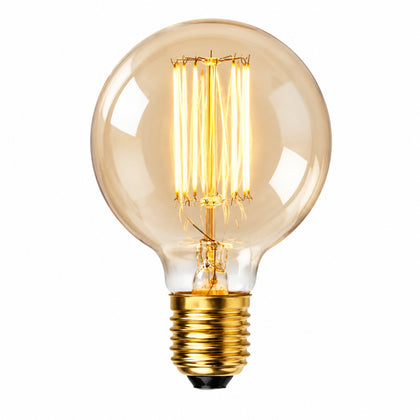
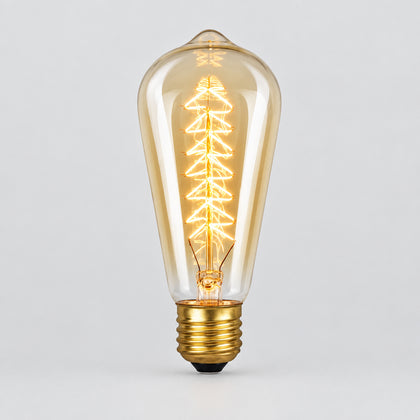
Star Spiral Filament LED Bulb E27 4W — 2700K Warm Amber, Low Energy, Vintage Edison Style
A decorative E27 LED bulb combining a star-shaped glass body with a spiral filament arrangement, delivering a warm 2700K amber tone at just 4W. CE, RoHS and CCC certified for EU and UK mains (220–240V). The decorative character of a vintage star bulb, with the efficiency and lifespan of LED technology. Bulb sold individually — fitting not included.
Technical Specifications
| Light source | LED filament — spiral, replaceable |
| Cap / Socket | E27 (standard Edison screw) — also fits E26 |
| Bulb shape | Star — pointed geometric glass body |
| Filament type | Spiral LED filament (decorative coil) |
| Wattage | 4W (equivalent to ~40W incandescent) |
| Colour temperature | 2700K — extra warm amber |
| Voltage | 220–240V / 50Hz |
| Glass | Clear — star-shaped pointed body |
| Certifications | CE (EU / UK), RoHS, CCC |
Star Spiral LED — Decorative Impact Without the Running Cost
This bulb makes the same visual argument as the tungsten star — the pointed glass silhouette, the warm amber glow, the shadow pattern on surrounding walls — but at 4W rather than 40W, and with a lifespan measured in decades rather than months. The spiral LED filament inside the star body adds a second layer of visual complexity: where a straight filament reads as a single glowing line, the coiled helix fills the star form with a continuous three-dimensional glow that is visible from every angle. The result is a bulb that is more visually active when lit than a standard straight-filament star, while remaining just as effective as a decorative object when switched off. At 2700K, the colour temperature sits in the same extra-warm amber range as the tungsten version — close enough that most people would not notice the difference in a finished room. The practical difference is in the running cost and the heat output: at 4W, this bulb generates minimal heat, making it safe to use in fittings with lower wattage ratings and in positions closer to soft furnishings.
Use this bulb in open or clear-glass fittings where both the star silhouette and the spiral filament are fully visible: exposed-socket pendants, cage wall lights, or a bedside table lamp with a clear shade. It is particularly well suited to bedrooms and reading corners where the fitting is on for several hours each evening — at 4W, the running cost over a year is negligible compared to a 40W incandescent in the same position. Browse our wall lights collection for compatible cage fittings, or read our lamp shades guide for advice on pairing open shades with decorative bulbs.
Common Questions
How does the spiral filament change the look compared to a straight filament star bulb?
+
A straight filament reads as a single glowing line — clean and minimal. The spiral filament is a continuous coiled helix that fills the glass body with a denser, more complex glow visible from every angle. In the star-shaped body, the spiral creates a layered effect: the pointed glass silhouette frames the coiled filament, giving the bulb two distinct visual elements rather than one. The overall impression is richer and more intricate than a straight-filament version of the same shape.
Is this safe to use in a fitting rated for 25W maximum?
+
Yes — at 4W, this bulb generates far less heat than a 25W or 40W incandescent and is safe to use in fittings with low wattage ratings. LED bulbs are rated by their actual power consumption (4W), not by their incandescent equivalent (40W). A fitting rated for 25W maximum can safely accommodate this 4W LED bulb. If in doubt, check the fitting’s label — it will specify the maximum wattage for incandescent bulbs, and any LED bulb drawing less than that in actual watts is safe to use.
Will the 2700K LED tone look the same as the tungsten star bulb?
+
Very similar, but not identical. Both are rated at 2700K, but tungsten incandescents produce a slightly deeper, more orange-amber tone — particularly at low dimmer settings, where the colour temperature drops further. The LED version maintains a consistent 2700K across its output range. In a finished room, most people would not notice the difference at full brightness; the distinction becomes more apparent when dimming, where the tungsten version goes deeper amber and the LED holds its colour temperature more steadily.
How much does it cost to run this bulb compared to the 40W tungsten version?
+
At 4 hours of daily use and an electricity rate of €0.40/kWh: the 4W LED costs approximately €2.34 per year to run. The 40W tungsten version costs approximately €23.36 per year — ten times more. Over the LED’s rated lifespan, the energy saving alone far exceeds the price difference between the two bulbs. If the fitting is used regularly, the LED version is the more economical choice by a significant margin.
Can I use this bulb in a damp location such as a bathroom or conservatory?
+
No — this bulb carries no IP rating and is not suitable for use in damp or wet environments. For bathroom or conservatory use, the IP protection must come from the fitting itself (IP44 minimum for bathroom zone 2). The bulb must remain enclosed within an IP-rated fitting and must not be exposed directly to moisture or condensation. In a dry conservatory used as a living space, it can be used in a standard indoor fitting without IP concerns.
Find a compatible fitting in our Wall Lights or Table Lamps collection. Free delivery on orders over €50. 30-day returns.