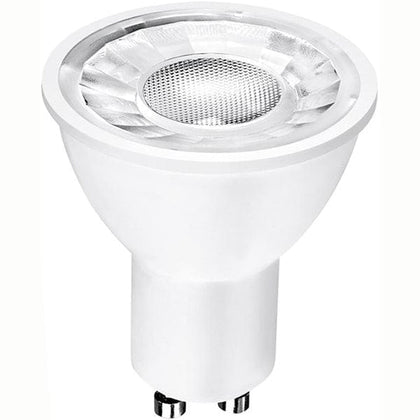
GU10 LED Spot Bulb — 5W, 2700K Warm White, 380lm, 36° Beam, Dimmable, 20,000h
A GU10 LED spot bulb — 5W, 2700K warm white, 380lm, 36° beam angle, Ø5cm × H5.4cm. Push-and-twist fit. Dimmable with a trailing edge dimmer. 20,000-hour rated lifetime. 220–240V.
Technical specifications
| Cap type | GU10 (push-and-twist) |
| Wattage | 5W |
| Colour temperature | 2700K — warm white |
| Luminous flux | 380lm |
| Beam angle | 36° — focused spot |
| Dimensions | Ø5cm × H5.4cm |
| Voltage | 220–240V |
| Dimmable | Yes — trailing edge dimmer required |
| Rated lifetime | 20,000 hours |
5W, 2700K, 36° beam — GU10 spot for downlights, spotlights, and track fittings
The GU10 is a push-and-twist spot bulb designed for directional fittings — downlights, spotlights, track lights, and adjustable ceiling spots. The 36° beam angle is a standard spot spread: focused enough to direct light at a specific area (a worktop, artwork, or shelf) without being so narrow that it creates a harsh circle of light. At 380lm and 5W, this bulb gives a useful output for task and accent lighting — more than the 350lm filament bulbs, and directional rather than omnidirectional. The 2700K warm white is the standard domestic colour temperature — noticeably warmer than daylight (4000–6500K) but not as amber as the 2300K filament bulbs. Dimmable with a trailing edge dimmer switch; a standard leading edge dimmer may cause flickering. Rated for 20,000 hours. 220–240V only.
Use this bulb in any GU10 fitting — recessed downlights, surface-mounted spotlights, track fittings, or adjustable wall spots. For kitchen worktops and task areas, 380lm per bulb is a good starting point; use multiple fittings for even coverage. Browse the full LED bulbs collection or read our guide to buying lights online for bulb selection advice.
Common questions
What does 36° beam angle mean in practice?
+
A 36° beam angle is a standard spot spread — it concentrates the light in a focused cone rather than spreading it in all directions. At 1m distance, a 36° beam covers approximately 65cm in diameter. This is suitable for accent lighting, artwork, shelves, and worktops. For wider area coverage, use multiple fittings or choose a bulb with a wider beam angle (e.g. 60°).
How does GU10 fit — push-and-twist or screw?
+
GU10 bulbs use a push-and-twist (bayonet-style) fitting — push the bulb into the socket and rotate it a quarter turn to lock it in place. To remove, rotate in the opposite direction and pull. This is different from E27 (large screw) and E14 (small screw) bulbs.
Why does this require a trailing edge dimmer?
+
Most LED bulbs work best with a trailing edge (electronic) dimmer switch. A standard leading edge (resistive) dimmer can cause flickering, buzzing, or a reduced dimming range with LED bulbs. If you are unsure which type of dimmer you have, check with your electrician before purchasing.
Is 380lm enough for a kitchen or work area?
+
380lm per bulb is a good starting point for task lighting, but most kitchens and work areas use multiple GU10 downlights for even coverage. A typical kitchen might use 6–8 GU10 downlights at 380lm each for adequate task lighting. For accent lighting (artwork, shelves), a single 380lm GU10 is usually sufficient.
Can this bulb be used on a 110V circuit?
+
No — this bulb is rated for 220–240V only. It is not suitable for 110V circuits (common in North America). Using it on a 110V circuit may damage the bulb or cause it to underperform.
Browse the LED bulbs collection or read our guide to buying lights online. Free delivery on orders over €50 — easy returns included.