


Lighting Advice Ireland: What to Check Before You Buy (and What Most People Get Wrong)

Quick answer
The three things most Irish homeowners get wrong: buying a fitting without checking ceiling height, choosing the wrong colour temperature (4000K in a sitting room feels clinical), and ignoring IP ratings for bathrooms. Fix those three first. Everything else is secondary.
Buying lighting in Ireland online should be straightforward. It usually isn't, because most guides are written for ideal rooms — high ceilings, large floor plans, professionally designed interiors. Most Irish homes are a semi-d or a terraced house with 2.4m ceilings, a narrow hallway, and a kitchen that does three things at once.
This guide covers what actually matters when choosing lights for those homes. No trend forecasts, no interior design theory. Just the decisions that determine whether a fitting works or gets returned.
Mistake 1: Not Accounting for Ceiling Height
The standard ceiling height in Irish homes built between 1960 and 2000 is 2.4m. That covers the majority of semi-detached and terraced houses in Dublin, Cork, Limerick and every county in between. It also rules out a lot of the lighting you see on Pinterest and Instagram, which is almost always shot in rooms with 2.8m or higher ceilings.
The practical rule: subtract 2m for comfortable head clearance. That gives you 40cm of pendant drop in a standard Irish room. Enough for a semi-flush fitting or a compact pendant over a dining table where people are seated. Not enough for a dramatic chandelier in the middle of a sitting room.
For rooms with 2.4m ceilings, the right choice for general lighting is almost always a flush or semi-flush ceiling fitting. Reserve pendants for over dining tables, kitchen islands, or any spot where head clearance isn't the constraint.
Newer builds and extensions often have higher ceilings — 2.6m to 3m is common in post-2000 construction. If you have the height, pendant lights and chandeliers earn their place. If you're not sure, measure before you order.
Mistake 2: Choosing the Wrong Colour Temperature
The Kelvin number on a bulb is the single most important specification most people ignore. It determines whether a room feels warm and liveable or cold and clinical. And it can't be fixed by dimming — a 4000K bulb at 50% brightness is still the wrong colour of light, just quieter.
| Kelvin range | How it looks | Right for | Wrong for |
|---|---|---|---|
| 2700K | Warm, amber-toned | Sitting rooms, bedrooms, dining rooms | Kitchens, home offices |
| 3000K | Soft white, slightly warm | Kitchens, bathrooms, home offices | Bedrooms |
| 4000K+ | Cool white, clinical | Garages, utility rooms | Any living space |
For Irish homes specifically, 2700K in sitting rooms and bedrooms is the right call. Ireland gets roughly half the sunshine hours of southern Europe. In January and February, it's dark by 4:30pm. Your artificial lighting isn't supplementing sunlight — it's replacing it for most of the evening. Warm light compensates for that. Cool white fights against it.
The most common mistake is buying "daylight" bulbs (5000K–6500K) thinking more blue equals more visibility. It does in a workshop. In a sitting room it makes the space feel like a waiting room. Avoid anything above 4000K in any room where you spend leisure time.

Mistake 3: Ignoring IP Ratings for Bathrooms
This one has real consequences. Installing a light fitting without the correct IP rating in a bathroom zone isn't just a style issue — it's a safety issue and a compliance issue under Irish Building Regulations Part M.
Bathrooms are divided into zones based on proximity to water. Each zone has a minimum IP requirement:
| Zone | Location | Minimum IP rating |
|---|---|---|
| Zone 0 | Inside the bath or shower basin | IP67 |
| Zone 1 | Directly above bath or shower, up to 2.25m height | IP65 |
| Zone 2 | Within 60cm of the bath or shower edge | IP44 |
| Outside zones | Rest of the bathroom | No minimum, but IP20+ recommended |
Most bathroom ceiling lights in a typical Irish en suite or family bathroom need to meet at least IP44. Always check the product specification before ordering. If a bathroom fitting doesn't list an IP rating, it's not rated for bathroom use.
A SELV (Separated Extra Low Voltage) circuit is also required in bathroom zones in Ireland — another reason all bathroom electrical work should be done by a registered electrician under ETCI guidelines.
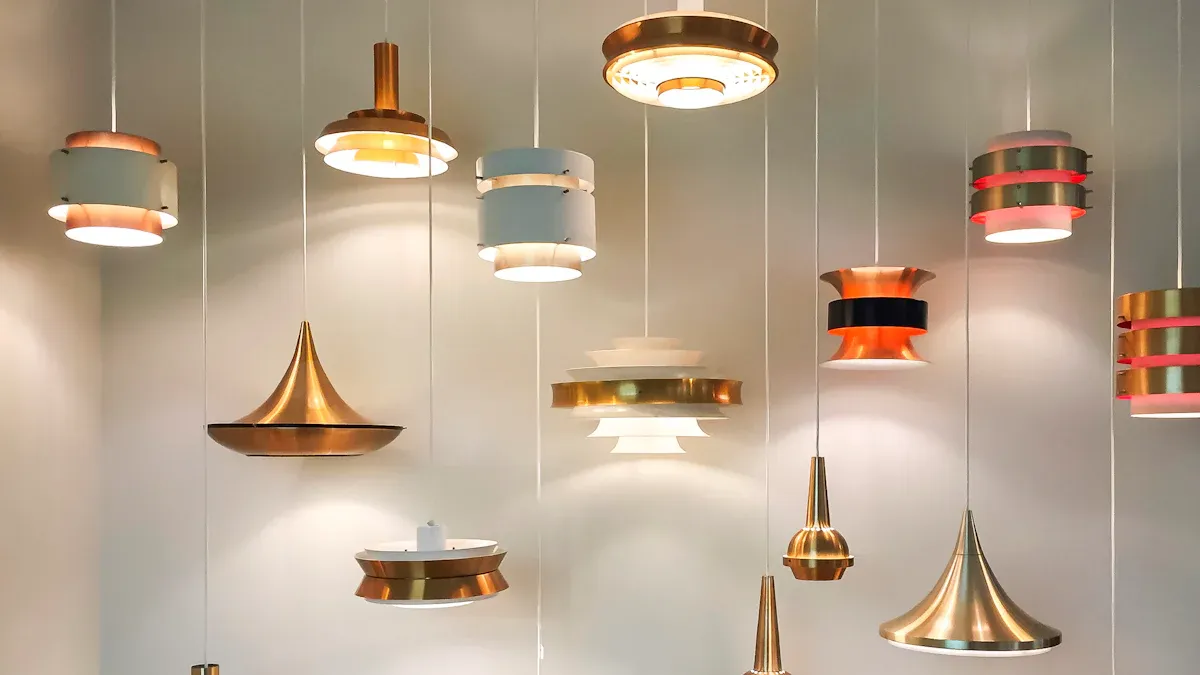
The Layered Lighting Principle — Applied to Real Irish Rooms
Most Irish rooms rely on a single ceiling fitting switched from the door. That's ambient lighting only, and it does everything badly — too bright for evenings, too flat for atmosphere, and it leaves corners dim regardless of the wattage.
The fix isn't buying more ceiling lights. It's adding a second and third source at lower levels.
Sitting room
One dimmable ceiling fitting at 2700K is your baseline. Add a floor lamp beside the sofa — plugged in, no installation, immediate result. That floor lamp at 30–40% brightness on a winter evening does more for the atmosphere of the room than any ceiling fitting can. Add a table lamp or wall light in the darkest corner and the room stops feeling like it has dead space.
Kitchen
Under-cabinet LED strips over the worktop are the most practical upgrade in any Irish kitchen. They cost under €50, require no electrician if battery or plug-in, and eliminate the shadow your own body casts when you're standing at the counter under an overhead light. Combined with a 3000K ceiling fitting and a pendant or two over the dining area, that's a properly lit kitchen.
Bedroom
A ceiling fitting at 2700K and a bedside lamp on each side. That's the minimum for a bedroom that functions properly. Bedside lamps allow one person to read without disturbing the other and provide the low-level light that a ceiling fitting never can. For small Irish bedrooms where nightstand space is limited, a wall-mounted reading light is the cleaner solution.
Hallway
Irish hallways are often narrow and underlit. A flush ceiling fitting every 1.5–2m gives even coverage without shadows. Wall lights on either side of a hall mirror add warmth and visual depth. Use 2700K–3000K throughout — hallways don't need task lighting, just comfortable ambient light that makes the entry to the house feel welcoming.
Lumens: What You Actually Need Per Room
Wattage is irrelevant for modern LEDs — it describes energy use, not brightness. Lumens describe brightness. Use these targets as starting points for Irish rooms with standard 2.4m ceilings:
| Room | Total lumens needed | Notes |
|---|---|---|
| Sitting room (20m²) | 1,500–2,500 | Spread across multiple sources |
| Kitchen (10–15m²) | 3,000–5,000 | Higher for task zones over worktops |
| Bedroom (12–16m²) | 1,000–2,000 | Lower is better for sleep quality |
| Bathroom (4–8m²) | 2,000–3,500 | Brighter at mirror, softer overall |
| Hallway | 800–1,500 | Even spread more important than total |
These are totals across all sources in the room, not per fitting. A sitting room at 2,000 lumens from three sources — ceiling, floor lamp, table lamp — will feel more balanced and comfortable than 2,000 lumens from one central fitting.
When to Call an Electrician
Plug-in floor lamps and table lamps need no electrician and no permission — from a landlord or otherwise. That covers a significant range of useful upgrades.
For anything involving fixed wiring — ceiling fittings, wall lights wired into the circuit, bathroom lights, outdoor wiring — a registered electrician is required under ETCI guidelines in Ireland. This includes adding a dimmer switch to an existing circuit. It's a straightforward job for any qualified electrician, but it's not a DIY task under Irish regulations.
If you're renting and want to improve your lighting without touching the wiring, floor lamps are your primary tool. A single floor lamp at 2700K beside a sofa transforms a flat more than almost any other single change.
Frequently Asked Questions
What's the best ceiling light for a standard Irish semi-d?
For rooms with 2.4m ceilings — which covers most Irish semi-detached and terraced houses — a flush or semi-flush fitting is the right choice. Aim for 1,500–2,000 lumens for a typical sitting room, 2700K colour temperature, and fit a dimmer switch while you're at it. Our White Industrial Ceiling Light at €29.90 is a compact flush fitting that works in any room with standard ceiling height.
Can I improve my lighting without hiring an electrician?
Yes. Floor lamps, table lamps, and plug-in under-cabinet LED strips require no installation at all. For most Irish sitting rooms, adding a floor lamp beside the sofa at 2700K makes a bigger difference to the evening atmosphere than replacing the ceiling fitting. No electrician, no landlord permission, no tools needed.
What colour temperature should I use in an Irish kitchen?
3000K is the right choice for most Irish kitchens. It's warm enough to feel inviting but bright enough for food preparation. For under-cabinet task lighting over worktops, you can go up to 3500K for added clarity. Avoid 2700K in kitchens — it makes the space feel dim when you need to see clearly, and avoid 4000K+ unless it's a utility room.
How do I know if a bathroom light is safe to install in Ireland?
Check the IP rating in the product specifications. For a ceiling fitting directly above a bath or shower (Zone 1), you need IP65 minimum. For fittings within 60cm of the bath edge (Zone 2), IP44 is the minimum. If the product listing doesn't show an IP rating, it's not rated for bathroom use. All bathroom electrical work in Ireland should be carried out by a registered electrician under ETCI guidelines.
What's the difference between lumens and watts?
Watts measure how much electricity a bulb uses. Lumens measure how much light it produces. For older halogen or incandescent bulbs, watts roughly predicted brightness — a 60W bulb produced a known amount of light. LEDs break that relationship entirely: a 10W LED can produce as much light as a 60W halogen. Always buy by lumens, not watts. The lumen output is listed on every bulb packaging and most product pages.
Ready to choose the right fittings for your home? Browse the full range at lighting-dublin.com — free delivery across Ireland on orders over €50, 30-day returns, and Irish customer support Monday to Saturday.